 Victoria Taylor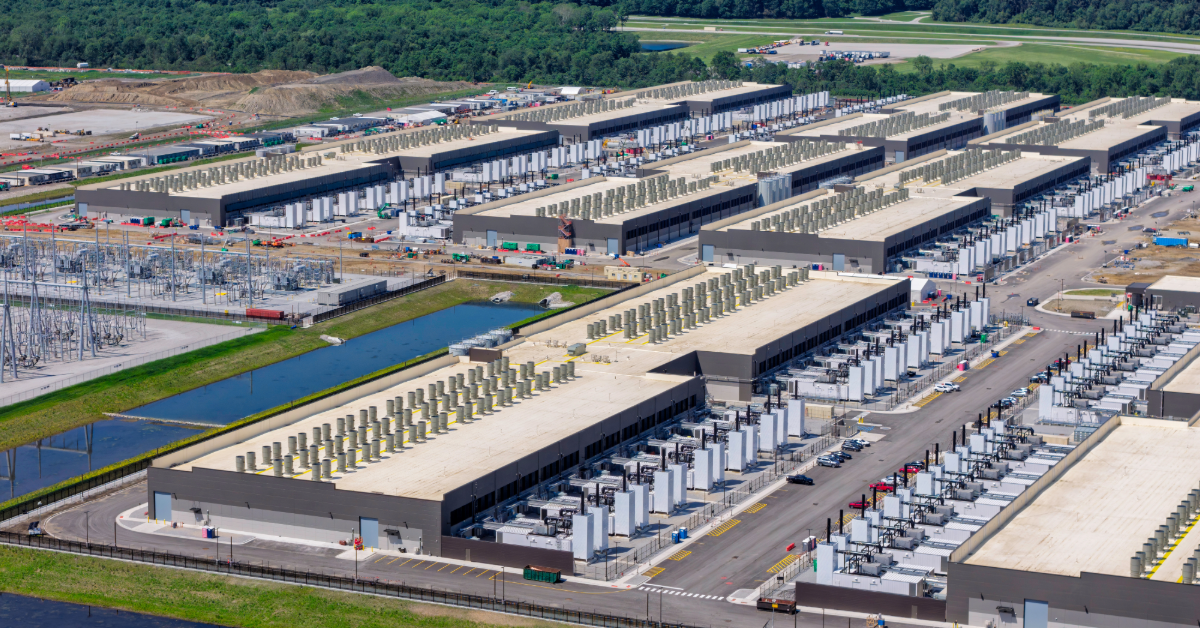
AI data centers are not a scaling story anymore. They’re a brand-new category of grid demand, and the industry is scrambling to keep up.
That was the theme of "Powering the AI Data Center Buildout: Siting, Interconnection, and Capital Risk for Large Loads," a webinar co-hosted by Energy Exemplar and KPMG. Four experts joined the conversation: Andrew Higgins, KPMG's Director of Energy Strategy and Interconnection, Dr. Joe Nyangon, VP of Solutions at Energy Exemplar, Alexander Macleod, Senior Energy Market Analyst at Energy Exemplar, and Tarek Ibrahim, Energy Exemplar's Head of Advanced Analytics. Together, they detailed why this is turning into one of the toughest problems in energy right now.
Why are AI data centers changing grid-demand planning?
From KPMG's vantage point, the shift is stark. From 2000 to 2020, electricity demand growth crawled along at about 1% a year, and utilities knew what to expect and planned accordingly.
That world is gone.
Anthropic alone is expected to need more than 11 gigawatts of compute over the next two years, a figure that exceeds Google's entire compute footprint. Projects that used to ask for 20 or 40 megawatts are now asking for entire gigawatts, sometimes overnight.
The real risk shows up when the demand doesn't. If a utility spends billions building infrastructure for a data center that walks away, ratepayers are left holding the bag. Higgins pointed out two specific pain points to watch:
- Microgrids in ERCOT have to self-fund services like voltage regulation and black start that the shared grid normally provides for free, which can knock 20 to 40% off a facility's usable capacity.
- Load balancing at gigawatt scale is uncharted territory. He referenced the South Texas nuclear plant outage in 2024, a 1.2 gigawatt event that stressed the system significantly, as a preview of what could happen with the far larger loads now coming online.
The takeaway is that this isn't a doom and gloom story. It's a design problem, one that requires new frameworks for how capital and risk get shared between utilities, developers, and the public.
What makes large-load interconnection so difficult?
Energy Exemplar took the numbers even further.
As of June 2026, ERCOT was tracking roughly 470 gigawatts of large load interconnection requests, with about 90% tied to data centers. But only about 9 gigawatts held actual approval to energize, against a real peak load of just 3.9 gigawatts, a conversion rate of around 1.6%.
PJM's story looks different but is just as tricky, forecasting about 70 gigawatts of incremental demand by 2038 while roughly 15 gigawatts of generation has already retired since 2022. ERCOT's issue is fundamentally a queue processing problem. PJM's is a resource adequacy and cost allocation problem. Same industry, same AI boom, two very different headaches.
Not all data centers are created equal. Edge sites, enterprise data centers, and colocation facilities make up the vast majority of buildings out there, but they barely register on the grid planning radar. The real disruption is coming from frontier AI training facilities and crypto sites converting to AI, a small slice of total facility count that's having an outsized impact on the system.
When it comes to siting, there are six factors that actually determine if a site works:
- Power Headroom
- Gas Deliverability
- Water Availability
- Fiber and Latency
- Tariff and Policy
- Labor and Land
Miss any one of these, and the "great site" on paper falls apart in practice.
How do AI training and inference create different grid risks?
Training massive models only pays off if people actually use them, and that means inference needs to happen closer to end users. And McKinsey estimates this distributed non-hyperscale inference layer could hit 28 to 42 gigawatts by 2030.
Energy Exemplar engineers ran a real-world test case on Houston, using the PLEXOS® platform, to see what siting a 25 megawatt edge data center would look like, and the results were eye-opening.
The search was narrowed down to six candidate nodes based on transmission access, then modeled available transfer capacity across each one. At night, there's plenty of headroom. But by mid-July at 2 or 3pm, when the grid is under real stress, that headroom nearly vanishes. Loads as small as 25 MW, which might seem trivial next to hyperscaler data centers, can have huge hidden reliability impacts during peak hours in dense pockets of the grid.
Density brings its own costs too. You can't run diesel backup generators in a crowded neighborhood, so you're looking at fuel cells or batteries instead, plus extra spending on aesthetics and noise mitigation that a facility out in rural West Texas simply doesn't need.
How can teams evaluate grid and capital risk together?
If you're evaluating sites for AI data centers, Energy Exemplar’s PLEXOS® platform is worth knowing about, since it tackles both the grid side and the financial side of the equation.
On the grid side, Available Transfer Capacity (ATC) analysis takes a long list of potential connection points and narrows it down fast, factoring in both normal and contingency conditions. From there, nodal analysis runs on a DC optimal power flow model to simulate the grid in detail, pinpointing exactly where and why congestion happens. That data feeds into site comparison workflows, which use shadow prices to flag locations likely to hit curtailment or price spikes. And because nobody has perfect visibility into what other market players will do, stochastic and Monte Carlo analysis helps capture that uncertainty, even modeling how it evolves over time. Time series hosting capacity rounds things out by giving a full annual picture instead of a single snapshot, so you can see how often a site is likely to face curtailment across the year.
The financial side gets just as much attention. Costs like land, labor, fiber access, cooling, and permitting success rates can all be built directly into the investment model. Backup or behind the meter generation can be modeled to see if and when it makes sense to sell excess power back to the grid. Load itself doesn't have to be treated as fixed either. It can be modeled as a soft, flexible constraint, letting you quantify the tradeoff between cutting load during a price spike and staying online.
Neither side tells the full story on its own.
Siting decisions need the grid and the financials working together to land on a location that actually makes sense.
What needs to change to support AI data-center growth?
AI's power demands are rewriting the rules of grid planning in real time. The good news, according to everyone on this panel, is that the problem is solvable. It just requires new tools, new tariff structures, and a lot more nuance than "build more power plants." Getting siting, interconnection, and cost allocation right isn't optional anymore; it's the foundation the entire AI buildout depends on.
Download the recording to listen to the whole conversation.
.png?width=622&height=350&name=Webinar%20Speaker%20announcement%20-%20May%2012%2c%202025%20at%2021.27.05-2%20(6).png)
Blog Sources:
Utility Dive: Facing an Estimated 474 GW of Interconnection Requests, Texas Hits Pause on Data Centers
ERCOT: PUCT Approves ERCOT's Batch Zero Process for Connecting Large Electricity Users While Protecting System Reliability for Texans
Thomas Gleeson Pablo Vegas Data Centers Directive Letter to PUCT ERCOT August_2026
McKinsey, The next big shifts in AI workloads and hyperscaler strategies
McKinsey, AI power: Expanding data center capacity to meet growing demand
IDC, Three forces shaping the future of IT leadership
From AI to the OBBBA: 4 Drivers Reshaping the U.S. Power Grid
 Rob Homer : September 15, 2025
Explore how AI-driven data-center demand, reliability risk, interconnection delays, and the OBBBA are reshaping U.S. power planning.
What FERC and USEA Conferences Reveal About Energy Reliability
Rob Homer : November 10, 2025
Key FERC and USEA conference insights on data-center demand, gas-electric coordination, market design, and integrated reliability planning.
How Data Center Growth Is Reshaping Power-System Planning
 Team Energy Exemplar : January 8, 2025
Learn how rapid data-center growth is reshaping generation, transmission, interconnection, and energy-planning decisions across the power system.