5 min read

How ERCOT Market Participants Turn Congestion Signals into Tested Decisions


ERCOT is a congestion-driven market and often framed as a forecasting challenge. In reality, it is a system problem driven by physics, topology, and constraints. Prices form at the node, not the curve. Transmission limits, outages, and dispatch decisions shape outcomes hour by hour. The system is changing fast. Renewable build-out, storage growth, load expansion, and transmission upgrades are reshaping how prices form and where risk lives.Teams are not asking, “What will prices be?”

They are asking:

  • Where will constraints bind? 

  • How will outages shift flows and spreads? 

  • How do assumptions hold as conditions change? 

Most tools stop at visibility. ERCOT demands a structured approach to decision validation.

This blog covers:


Why ERCOT decisions are complex


ERCOT compresses time and increases complexity. System conditions can shift within hours as outages, weather, and dispatch decisions change flows across the network. 

At the same time, market timelines require participants to act quickly, often with limited time to validate assumptions.  Congestion Revenue Rights (CRR) traders price congestion across thousands of node-to-node paths.  Planners evaluate multi-year changes in topology, generation mix, and load.  Developers assess nodal capture and curtailment risk before committing capital.

The challenge is balancing:

  • Speed for trading decisions

  • Confidence for investment decisions

  • Defensibility for planning and regulatory outcomes 

Most teams operate across fragmented tools and disconnected workflows. Internal models require constant maintenance. The complexity of maintaining topology and outage assumptions creates a lag between ERCOT system conditions and actionable analysis. Constraint screening and scenario testing remains labor-intensive and requires manual effort. Static forecasts fail to reflect system dynamics. Zonal views obscure nodal congestion where value is created or lost.

The result is a widening gap between system reality and decision workflows.

From signal to decision: a structured workflow


ERCOT workflows require more than forecasts.

They require a structured path: Signal → Scenario → Decision

PLEXOS® supports this workflow across both visibility and simulation with PLEXOS® Insights.

  • “PLEXOS® Insights for ERCOT – Short-term Trading” provides forward visibility into near-term price and congestion risk 

  • “PLEXOS® Insights for ERCOT – CRR Trading” surfaces congestion signals aligned to monthly auction timelines 

  • “PLEXOS® Insights for ERCOT – Medium-term Reference Case” provides a forward multi-year view of structural system trends 

These signals identify where the system is moving.

PLEXOS® Playbooks then enable scenario testing and validation against system behavior, with the ability to adjust key assumptions and test sensitivities within a structured framework.

Together, this connects market signals to system-based decision-making.

CRR trading: from congestion signal to bid validation


CRR trading is driven by constraint behavior. The objective is not simply to forecast prices, but to quantify how binding transmission constraints impact nodal spreads and congestion value.

This requires capturing the system mechanics that govern congestion outcomes, including:

  • How generators and loads are impacting congestion in the system. 

  • How outages redistribute flows under contingency conditions.

  • How outage driven topology changes impact constraints over time

  • How shadow prices on binding constraints translate physical congestion into economic value

The PLEXOS® Playbook for ERCOT – CRR Trading is designed for this workflow.

It uses monthly auction-aligned topology to model:

  • Transmission constraints and contingency definitions 

  • Outage schedules and network reconfiguration

  • Hourly nodal price formation using Direct Current (DC) optimal power flow

  • Shadow pricing associated with binding constraints that drive congestion rents

This enables:

  • Identification of constraint-driven spread formation

  • Scenario testing under outage and weather-driven system variability

  • Validation of CRR paths across evolving system conditions

  • Recalculation of expected congestion value prior to bid submission 

Rather than relying on a single forecast, teams use scenario analysis to evaluate how constraints behave across conditions, grounding CRR decisions in modeled system behavior.

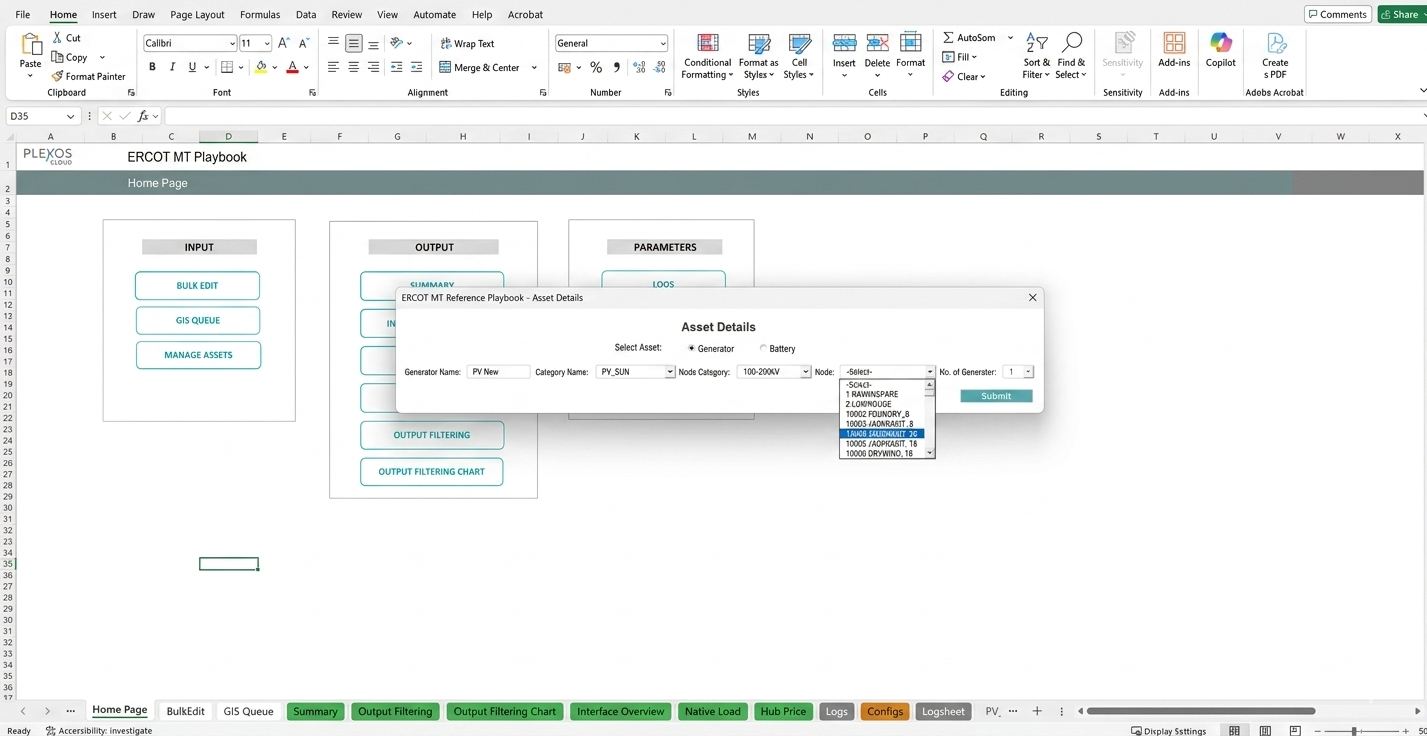
PLEXOS Playbook for ERCOT - CRR Trading


This image shows the PLEXOS® Playbook for ERCOT – CRR Trading, where users move from market signals to scenario testing and decision validation.

From the homepage, users can load an ERCOT CRR study from PLEXOS® Cloud, adjust key assumptions such as outages or assets, and run sensitivities within a structured workflow. The interface also provides built-in analysis tools to compare results, including changes in prices, congestion, and constraint behavior across scenarios. 

Medium-term planning: modeling ERCOT as it evolves

Planning in ERCOT is structural and fundamental.

Forward curves and historical performance do not reflect system evolution.

The PLEXOS® Playbook for ERCOT – Medium-term Reference Case models ERCOT as a physical system.

It integrates:

  • Seasonal transmission topology from Steady-State Working Group (SSWG) cases

  • Planned outages and transmission upgrades

  • Generator interconnection and renewable build-out

  • Storage participation and load growth

  • Fuel inputs and marginal cost formation 

The model enforces constraints and co-optimizes dispatch to produce:

  • Hourly nodal, hub, and settlement point prices

  • Congestion patterns and constraint frequency

  • Curtailment outcomes for renewables

  • Hub-to-node and node-to-node spreads 

Physical network conditions drive congestion, basis formation, and spread durability.

This is not a statistical forecast. It is a physics-based, fundamentally modeled simulation of ERCOT system behavior.

Scenario testing at the structural level

The value lies in testing structural change.

Teams can:

  • Add generation at specific nodes and re-solve the system

  • Adjust renewable penetration and observe curtailment impact

  • Adjust load assumptions, including large fixed loads such as data centers

  • Modify transmission capacity or outage duration

  • Adjust fuel curves and observe marginal unit shifts 

Each scenario runs on a consistent nodal framework.

This provides:

  • Results comparison across scenarios

  • Clear attribution of price changes

  • Differences in results reflect assumption changes rather than model inconsistency

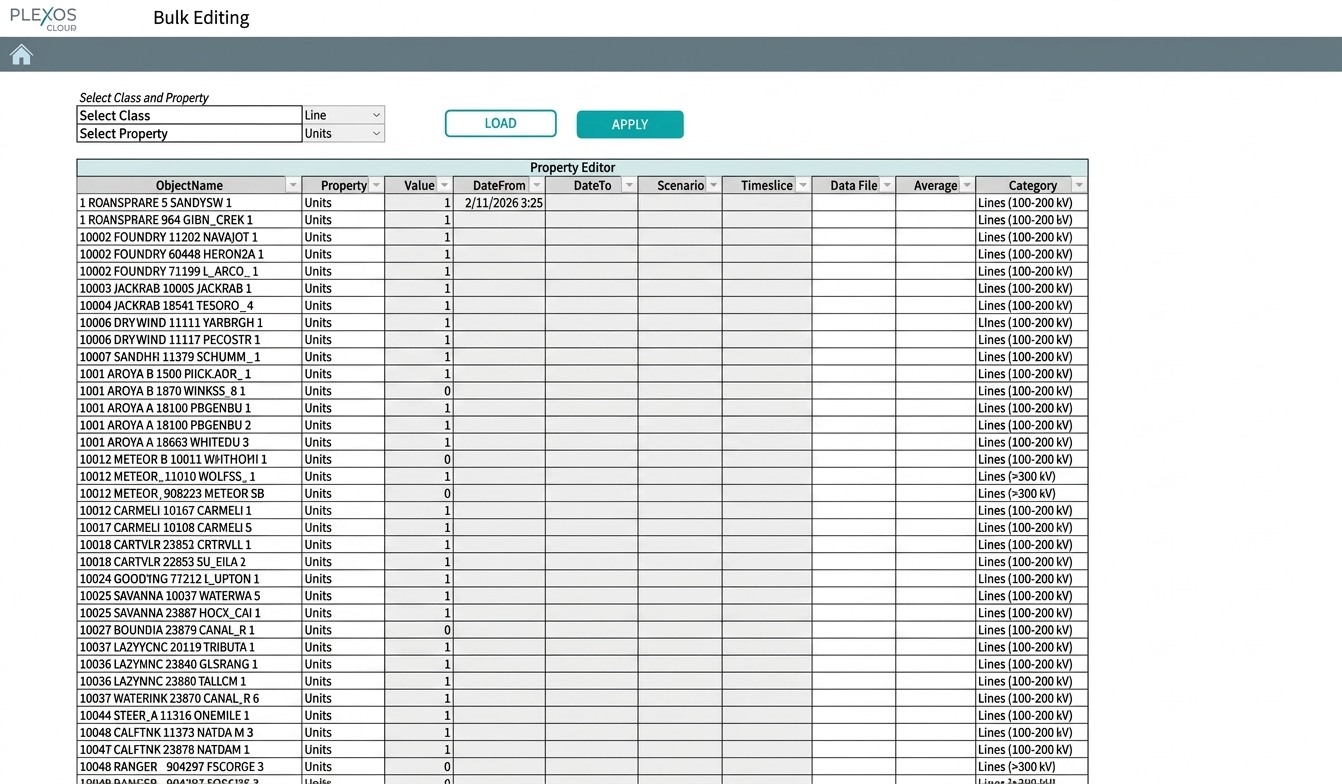
PLEXOS Playbook for ERCOT - Medium-term Reference Case

This image shows the PLEXOS® Playbook for ERCOT – Medium-term Reference Case, where users test how structural changes impact the system over time. From the bulk edit interface, users can adjust key assumptions such as generation assets, load growth, and transmission conditions within a consistent nodal framework. The Playbook then enables scenario testing and comparison, allowing teams to evaluate how changes in infrastructure, new assets, or system conditions affect prices, congestion patterns, and overall market outcomes. 

How PLEXOS® Playbooks support decision workflows

Time is a primary constraint in ERCOT workflows. Model construction, data alignment, and scenario configuration often limit how quickly teams can respond to changing system conditions. PLEXOS® Playbooks restructure this balance.

They deliver:

  • A pre-built ERCOT nodal model

  • Calibrated datasets aligned to system fundamentals

  • Scenario-ready workflows

  • Cloud-based execution of simulations

Scenarios run within a consistent structural framework, without requiring direct interaction with the underlying model architecture.

Teams can:

  • Perform rapid scenario execution

  • Focus on constraint behavior and price formation

  • Iterative decision analysis without model rebuilds 

This approach aligns decision workflows with the pace of ERCOT system change.

How PLEXOS® Insights supports signal identification

ERCOT decisions begin with signal detection. PLEXOS® Insights provides forward visibility across three ERCOT workflows:

  • PLEXOS® Insights for ERCOT – Short-term Trading

  • PLEXOS® Insights for ERCOT – CRR Trading

  • PLEXOS® Insights for ERCOT – Medium-term Reference Case 

These products surface forward signals across:

  • Nodal price movement

  • Emerging congestion patterns

  • Outage-driven system changes 

Signals emerge directly from evolving system conditions, providing early visibility into where structural shifts occur across decision horizons.

See PLEXOS® for ERCOT in action

The way you model ERCOT shapes the decisions you make. Build a clearer view of congestion, price volatility, and resource adequacy with a platform designed for real market complexity.

Learn More about PLEXOS Playbooks


Frequently asked questions about PLEXOS® for ERCOT  


Energy Exemplar remains dedicated to continuous development, bringing you the most powerful and user-friendly energy modeling solutions available. Stay tuned for even more exciting features coming soon! 

Start planning with PLEXOS today

An energy modeling platform that's more customizable, more connected, and provides more insights than ever before. Make the switch to PLEXOS today. 

What's New - December 2025

Each month, we highlight the latest enhancements made across the PLEXOS® platform to help you model faster, plan smarter, and collaborate more...

Read More

How PLEXOS® Insights Help ERCOT Traders, Planners and Investors See Risk Before It Strikes

If you trade, hedge, or plan in the Electric Reliability Council of Texas (ERCOT), you know how fast market conditions shift, and how difficult it...

Read More

What's New - March 2026

Energy decisions are becoming more complex, timelines are tightening, and expectations for transparency are increasing. This February 2026 release...

Read More